I promised at the end of my last post that I would offer a few words on Cao Xue-qin (曹雪芹), the author of the Story of the Stone. Really, I want to offer some thoughts on the fairly complicated issue of just who wrote the Stone (or, more precisely, who wrote which parts of it) and what that means for us as readers. This will let me address Sun Laoshi’s thoughts about reading the novel and our general attitude toward fiction in general.
In its most complete versions, The Story of the Stone has multiple authors, of whom Cao Xue-qin is just the foremost. That is, it’s generally accepted that Cao invented the world of the Stone and wrote the first eighty of its one-hundred-twenty chapters, though even this statement bears qualifying. For it’s clear that Cao wrote the story in installments, drafts of which he passed among an intimate circle of readers who commented on them extensively in manuscript drafts. These commentators played an important enough role as readers, in fact, that they seem to have helped shape the story, persuading Cao to alter some key narrative arcs. Most notably, there are hints in early chapters that suggest that Cao revised the cause of death of a major character, Qin Shi (or, more familiarly, Qin Ke-qing). While there are oblique, riddling suggestions that in his first telling, Cao had her hanging herself as a result of the shame of an illicit affair with her father-in-law, in all the extant versions we have inherited, she dies instead of a prolonged, mysterious illness. The original story line, it seems, was too close to home for at least one of Cao’s early readers, who thought he recognized the real-world model for Ke-Qing and praised Cao for relenting on making as direct a depiction of her death as he seems originally to have offered. However, without gainsaying such evidence of Cao’s self-editing in light of his readers’ feelings, Haun Saussy (whom Sun Laoshi cites in her post below) offers a plausible reading of the character of Qin Ke-qing rather as an elaborate ruse for unwary readers (even those as close to Cao as was his first circle of commentators) who might be eager to assign “historical” significance to what are, at bottom, ineluctably “fictional” constructions.
Here I myself can only hint at the kinds of literary complications Saussy finds in Cao’s text (readers curious about the details of Saussy’s argument can find his article in the Some resources . . . post below at the link “Reading and Folly”). Suffice to say that from the very outset, Cao intended to confuse his own authorial intentions through a very careful, persistent weaving of elaborate literary devices (puns, anagrams, riddles and tropes of shifting signification) into his otherwise decidedly naturalistic depictions of psychologically complex characters. That is, the reader finds herself experiencing a kind of parallax, her focus perpetually shifting between the vivid realism of Cao’s narrative and the quasi-logical, purely cognitive linguistic play that persists just below the surface narrative and repeatedly insists on the unreality of the entire imaginative edifice.
The most prominent instance of such layered significance appears early in the first chapter, appropriately enough, as the narrative leads us toward the gate into the Land of Illusion (where, having passed under it, the narrative leaves us for most of the remaining couple thousand pages). Inscribed on either side of the gate, we read the following (in David Hawkes’ rendering):
Truth becomes fiction when the fiction’s true;
Real becomes not-real where the unreal’s real.
In English, the couplet presents a somewhat lackluster tautology. In Chinese, however, the lines offer a lapidary, layered significance within the incantatory inevitability of their prosody. Below the surface alternation of fact and fiction that comes to the fore in Hawkes’ English rendition, the Chinese punningly smuggles in the names Cao gives to the two main families who will come to populate the narrative in side-by-side mansions linked by the fantastic garden that provides the heart of the novel’s action. To wit:
假作真时真亦假,
无为有处有还无。
Jiǎ zuò zhēn shí zhēn yì jiǎ,
wúwéi yǒu chù yǒu hái wú
Looking at the first line, we see that Cao has set up not just a philosophical but a literary puzzle as well. “Jia” is the patronymic of the leading family of the novel, who inhabit the “Rong-guo” mansion where most of the action takes place; it’s also a homophone for the Chinese character meaning “false,” or counterfeit. The “Zhen” family, meanwhile, represent a parallel and in fact senior lineage, and inhabit the Ning-guo mansion across an alley; their name is a homophone for the character meaning “true,” or real.
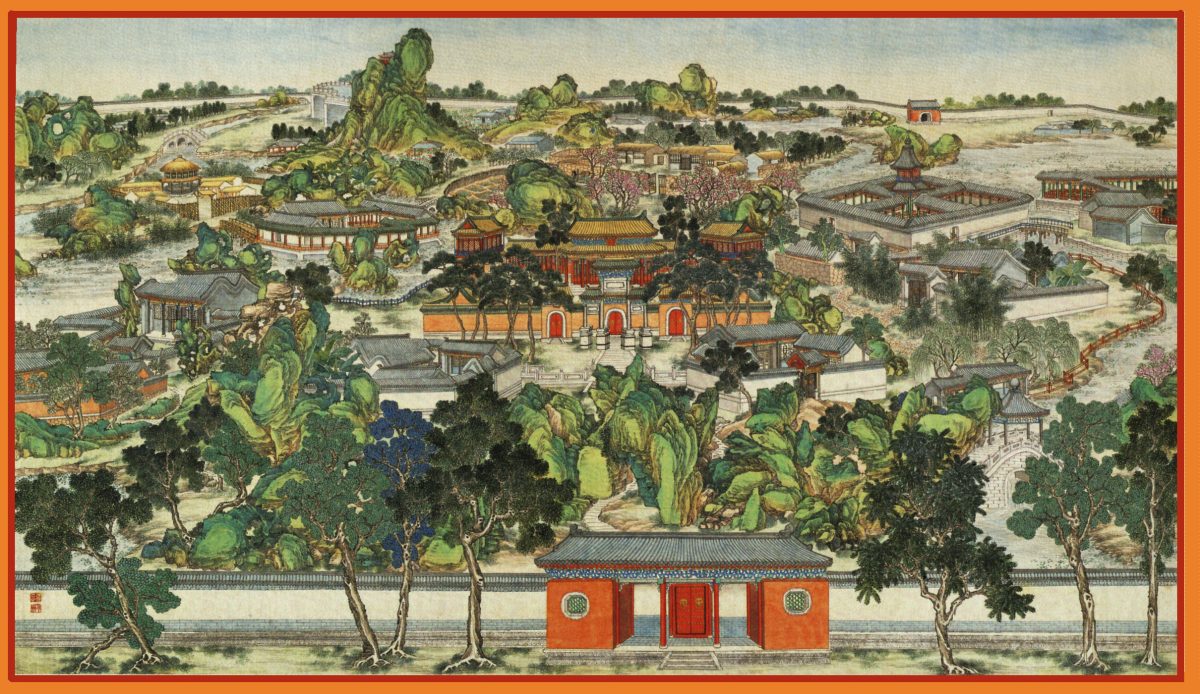
To sort one’s cast (which comes to number in the hundreds) into this binary with gratuitously suggestive names might signal a peculiarly crude allegorical program. Yet with such tender delicacy of feeling and observed, realistic detail does Cao present the ‘fictions’ who inhabit these names that both of his riddles – philosophical and literary – escape becoming stale conventions and serve rather to deepen our sense of the multi-dimensionality of the characters and their world. At the same time, the thoroughness of the illusion of reality also compels us to keep reading further into the fiction for some way of telling the literary and philosophical images from their objects. Tellingly, not long into the narrative, the walls that separate the Rong-guo and Ning-guo mansions are breached to make room for the “Prospect Garden” that becomes the setting of most of the middle third of the novel. There, the interplay of Jia and Zhen, fact and fiction, comes to parallel a whole series of further binaries – male and female, master and servant, reason and emotion, nature and artifice – all of which begin to swirl into each other in the ebb and flow of yin and yang that governs the whole and makes a mockery of any attempt to fix a hierarchy of significance in support of any single statement of the novel’s meaning.
Such layerings of meaning, in brief, illustrate how Cao succeeds in turning perfectly intelligent and sensitive souls into “shrimps,” in Sun Laoshi’s telling. I have told myself (and her) that I personally feel immune to such a fate, if only because of my limited skills as a solver of riddles, much less because I have a woefully limited time left to me on this earth to delve into a monument of punning in a punning language that I have too little time to master.
All this said, however, it is not so much Cao’s literary games that seem most to entice that species of “redologist” of whom Sun Laoshi writes. They, the revered shrimps of Harbin University, much like the monk and Taoist who first encounter the Stone at the foot of Greensickness Peak*, would seem to walk half in this, half in another realm of reality. But their project, as often as not, has long been to chart the frontier where both realms overlap – namely, the real world referents for Cao’s imaginings, like the unfortunate girl who served as the model for Qin Ke-qing but of whom no one has identified the body. For many scholars of the novel, she is just one among hundreds of reticent creatures lurking in archives, like Cao and his own aristocratic family, who are hiding in plain sight in the pages of his novel. Indeed, perhaps the closest we get to Qin Ke-qing and the other “females, conspicuous, if at all, only for their passion or folly” about whom the novel purports to have been written (according, that is, to the Stone itself in the first chapter) are a series riddling verses presented early on in a dream of Bao-yu’s in which he wanders through a kind of archive of the land of Disenchantment and reads from a register as enticing but opaque as any archive yet scoured for clues as to the “real” identities of Cao’s fiction.
In the end, and partly because we can only be confident that Cao himself wrote the first two thirds of the novel, readers of the earliest print versions, and since then all redologists (again, among whom I am comparable only to the tiniest of plankton!) have had to puzzle over far more enticing but thinner and less edifying riddles as to who wrote the last forty chapters. Suffice to say that theories abound, with which we will grapple as we approach that still fairly distant shore.
One wonders, in this light, if Cao himself was preparing not to finish his own novel by starting as he did and sowing so many questions as to the reality within, and behind or beyond, his work. Likely as not, he would rather have left us with purely literary and philosophical puzzles, rather than adding autobiographical and historical dimensions to them by not finishing his own work. Yet so thoroughly and concisely has he set up questions of when and how we pass from real to fictional and back again that his not having finished his own story seems somehow, tragically – but, for that, inevitably – apropos.
For a future post, I will try to put these ruminations on Cao’s work as an author into a context dealing with the problem of genre, and just how we in the west think of a “novel” and how The Story of the Stone compares.
* (qinggengfeng, in Pinyin, which I note here to tease you with another of Cao’s punning threads, i.e. on the many overtones of “qing,” of which more in a later post).

 The Story of the Stone