My research is still in early stages, for when approaching topics such as philosophy and culture, it is unwise to make assumptions and take short cuts. These two topics are so rich and it is essential to understand the foundations before attempting to draw conclusions.
This being said, where my research has taken me is a development of basic understanding of Chinese schools of thought beginning with mythology and philosophy. In order to answer the question of why Chinese society places values on specific aspects of culture– such as a relationship with the environment– we must first discover the influence of divine thought.
The main philosophies that I have been researching are Confucianism, Daoism, and Buddhism. Each promote separate life values, thus will promote separate approaches to life. For the sake of the direction of my research, I have decided to refer to and research these as philosophies rather than religions. Before looking at any of these separately, it is important to note that we must avoid studying them through a western lense. Unlike Abrahamic religions that western society is typically more accustomed to, eastern thought is collective. These philosophies are in conversation with each other. Especially in Chinese society, it is common to see practices from each school of thought being carried out in one’s life. Belief and preference of one philosophy does not discredit the value of another. However, for the time being, I will be examining each independently.
Confucianism was born during 6th and 5th centuries B.C.E. during a time of political unrest in China. Confucius’ teachings focused heavily on morality and filial piety. He believed that good government should rule by moral example. Filial piety set the tone for all relations in China. To be “good”, one must follow the workings of filial piety and respect their elders and those in authority. In the fall I briefly studied Mengzi by Mencius, a famous philosopher on Confucianism. I will review this work to look for explicit examples of why Chinese society defines certain actions as “right” or “wrong”.
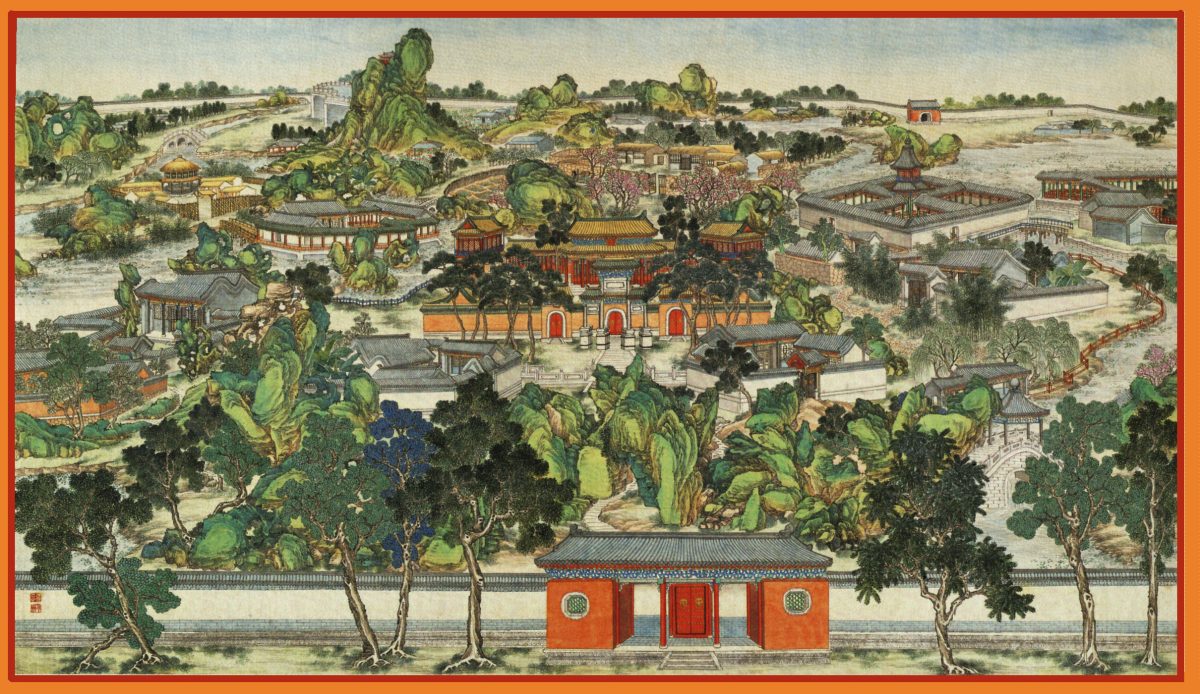
In Hong Lou Meng, we see the character Bao-chai portraying Confucian ideals. She addresses each person according to their role in society and the family. Her actions are focused on her development for her future roles, like being a wife. We can see this played out in her and Bao-yu’s relationship. For my research, I will begin to identify explicit scenes in which Bao-chai exemplifies Confucian ideals.
Daoist teachings focus heavily on “the way”– the path of nature. One may only flourish if “the way” or “the dao” is in balance. Daoism is directly connected to nature and can be more easily understood when thinking of a river. One can work to make things happen in their life, to change their life, but ultimately, the river will flow where the river flows. A person cannot simply change that path. Instead, they should embrace it. Alongside Mengzi, I studied Zhuangzi in the fall. This work has been of particular interest to me as I have formed my research. It is my hope that further studying of Zhuangzi and scholarly articles focused on Zhuangzi will lead my understanding of Chinese society and attitudes toward the environment.
In Hong Lou Meng, Dai-yu represents a Daoist lifestyle. She tends to follow instincts and whims rather than formal societal roles. While she may first appear to be immature and irrational, after recognizing the influence on Daoism on her character, her behavior gains depth. Daoism emphasizes following The Way, which is separate for each individual and is not a written path. It is focused more so on the moment– which is where we typically see Dai-yu’s mind. Her behavior is not tactically constructed around the future, rather it is reacting to the present.
Buddhism originated in India and traveled to China at some point after 300 B.C.E. I am somewhat familiar with Thai Buddhism, so trying to differentiate between the two branches (Thai Buddhism and Chinese Buddhism) has been a bit of a learning curve. The main teachings of Buddhism are that one must follow the Eightfold Path in order to reach Nirvana. This process includes karma and reincarnation whilst one works toward enlightenment. Buddhism focuses on removing desire to remove suffering. My research on Chinese Buddhism is the most underdeveloped presently. I have yet to identify specific supplemental works to assist in this area of thought and will need to search for areas in which it is represented in Hong Lou Meng.
A resource shared with me by our partners in China provided a chapter with multiple Chinese legends. This chapter, “Chinese Historical Tales, Myths, Fables and Legends” provided around forty stories that can be applied to various aspects of life. The myths that I am particularly interested in investigating further or that may support my research are “The Creation of the Earth,” regarding Pangu; “Nu Wa Made Man” and “Nu Wa Mended the Sky”; “Jing Wei Tries to Fill the Sea with Pebbles”; “Da Yu Led People Curbing Floods”; “To Help the Shoots by Pulling them Upward”; and “When the Man on the Frontier Lost His Mare, He Guessed it Was a Blessing in Disguise”. I also found a video explaining very basic Chinese mythology, which speaks more on Pangu which I will link here: https://youtu.be/G7vget_QAmo. I have yet to identify specific areas in which these mythological thoughts have been represented in Hong Lou Meng.
As previously stated, Chinese philosophies are in conversation with one another. It is more likely to see a hybrid practice of the three main schools of thought, Daoism, Confucianism, and Buddhism, rather than practiced individually. As they relate to our main vehicle of study, Hong Lou Meng, I plan to emphasize my study on Daoism and Confucianism as they are more prevalent in the work. I am especially interested in researching more on Daoism due to its direct connection to nature.