
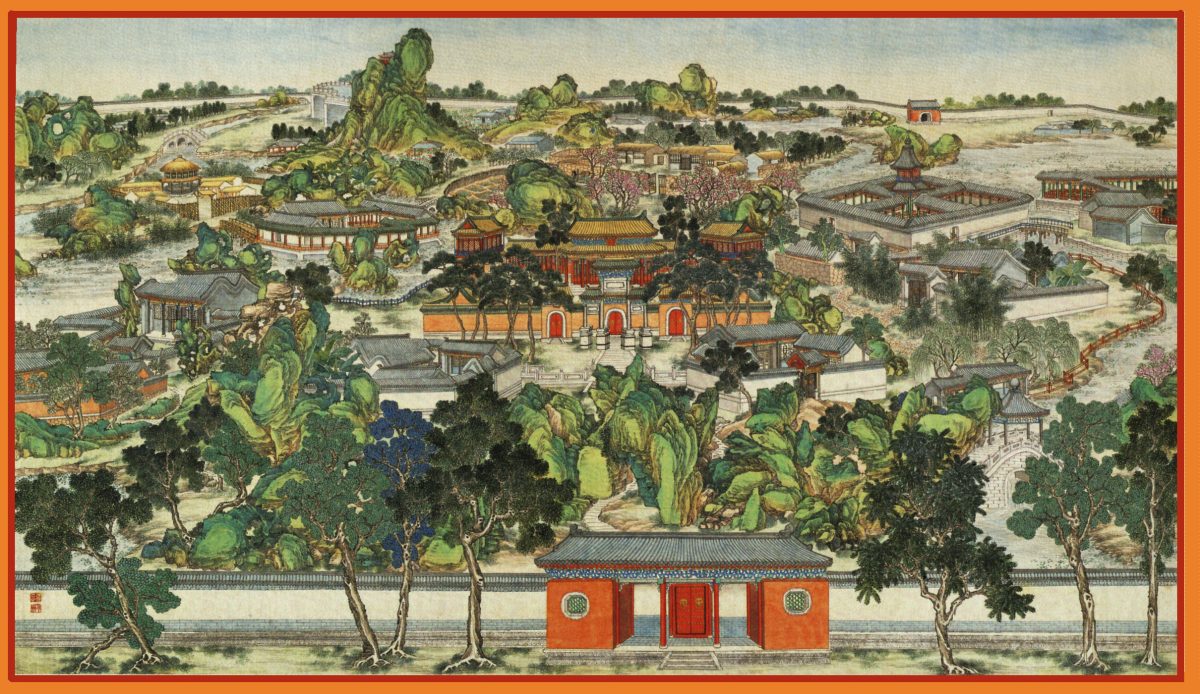
Happy Father’s Day, everyone! Since we’ve parted ways to read the novel on our own, I’m reflecting on my readings and diving into the text, more deeply into parts that speak to my topic, and doing a quicker content-based reading into those parts that don’t. The more prepared we get for this trip, the more unprepared I feel! Reading the book is a monumental task, but pacing myself has been extremely helpful (though I’m still a little behind!). Reading HLM is like exploring a garden that seems to change and shift around you, where everything is open to interpretation yet worth a second look… Maybe I read that in a book somewhere?
I’ve narrowed my topic down to the social context of poetry in HLM, which I am defining as tracking how and when characters use poetry, and what the addition of poetry to the text does for the events and players in HLM. I’m paying close attention to the situations in which recited or written poetry features, and comparing how these situations unfold.
I’ve also noticed the vast differences in approach to poetry by gender. Not even necessarily in terms of subject matter or temperament, but in how and when characters are motivated to use it. For example, in chapter 17, when the landmarks in the garden are getting their names, Bao-yu’s father Jia Zheng turns the experience into a way to test Bao-yu. It’s an aggressive interrogation of his literary skills, and even though the literary men Jia Zheng travel with seem to agree with (and are impressed by) Bao-yu’s suggestions, Jia Zheng rejects or attempts to improve most of his suggestions. In the end, Yuan-chun gives the final names to all of the landmarks in the garden. None of Bao-yu’s original suggestions are kept, but she modifies them expertly and these names are the ones that stick. After all that fuss, she has the final say! In much the same way that women have a surprising role in the official business of the household (an alternately subversive and parodical one)
Tan-chun (my current favorite character, for her literary precociousness) starts the Crab Flower Club by inviting Bao-yu to join a poetry writing collective. Together with a group of women, Bao-yu starts another literary venture in the garden, but this time the competition is understood as friendly and funny. It doesn’t have the same stakes, but is still rule-based and taken seriously. Jia Zheng’s literary competitiveness is not ultimately collaborative like the Crab Flower Club. The Crab Flower Club abstracts itself somewhat from the real world. Even though their poetry is based on subjects chosen from the garden and structured, it seems to happen on a kind of fantastical plane. Each poet in the club takes on another name, derived from literature and poetry, and to a certain extent embodies the characteristics of their namesake. It might be a separate project to examine the referenced characters and see how the poetry compares!
And the club’s inaugural crab-eating party, the poetry takes a decidedly non-serious turn as each poet attempts a comedic crab poem, cementing the word play of “crab” and “flower” club, and converging the worlds of dramatic and the comedic. But when the meetings adjourn, the situation of the club doesn’t follow into the business of the household. The abstractness of the club and the escapism of the pen names can’t follow, even in the same way the named landmarks of the garden do.
I’ll be interested to see how the club changes as the book continues, and how the poetry and social circle of poets evolves!
 The Story of the Stone